A modern, self-hosted movie collection manager. Built on lessons learned from the *arr ecosystem —
lightweight, fast, and designed from scratch in Go and React.
$docker run -d-p 8282:8282 -v data:/config ghcr.io/luminarr/luminarr
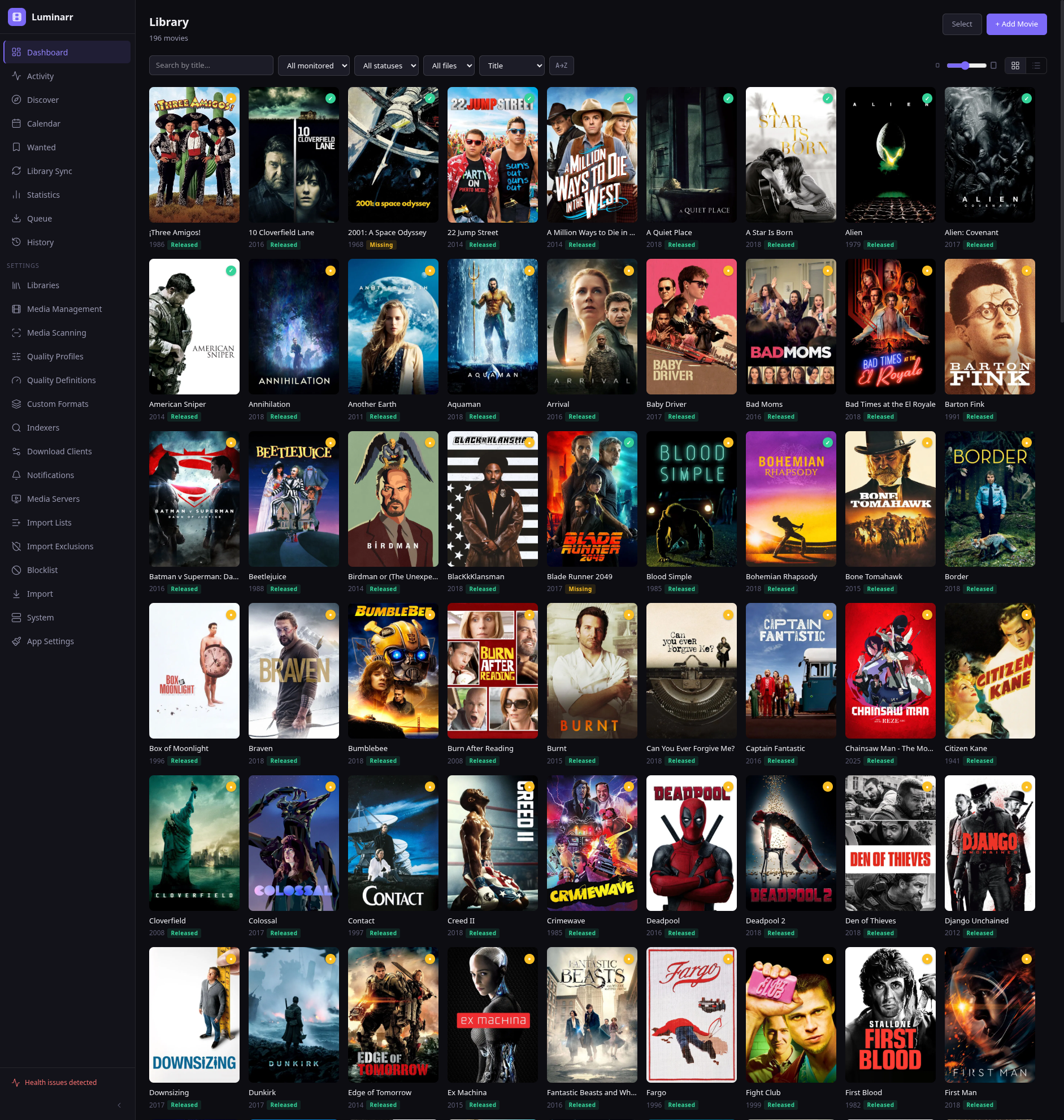
Movie library with poster grid, status badges, and quality filters
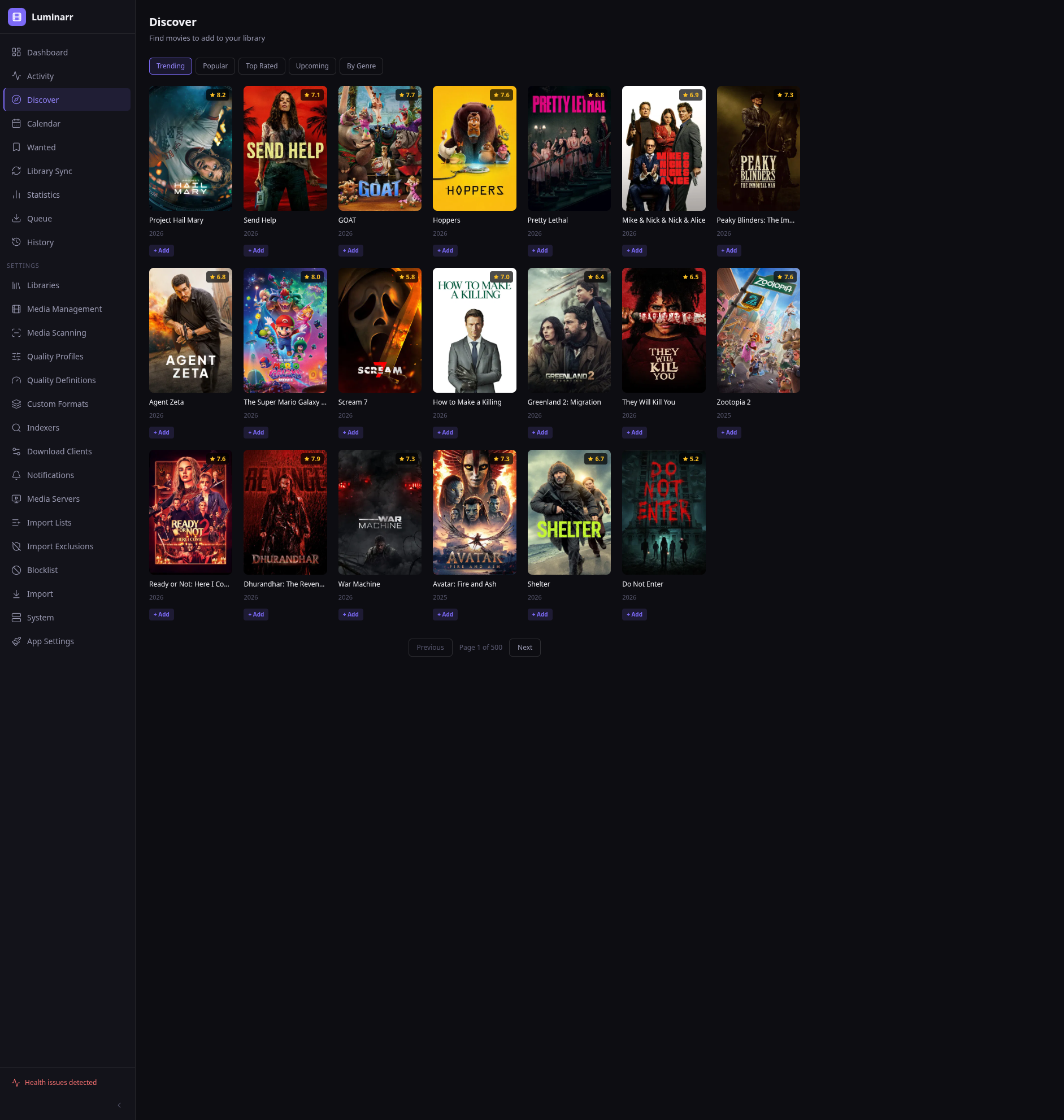
Discover — browse TMDB trending, popular, and by genre. One-click add.
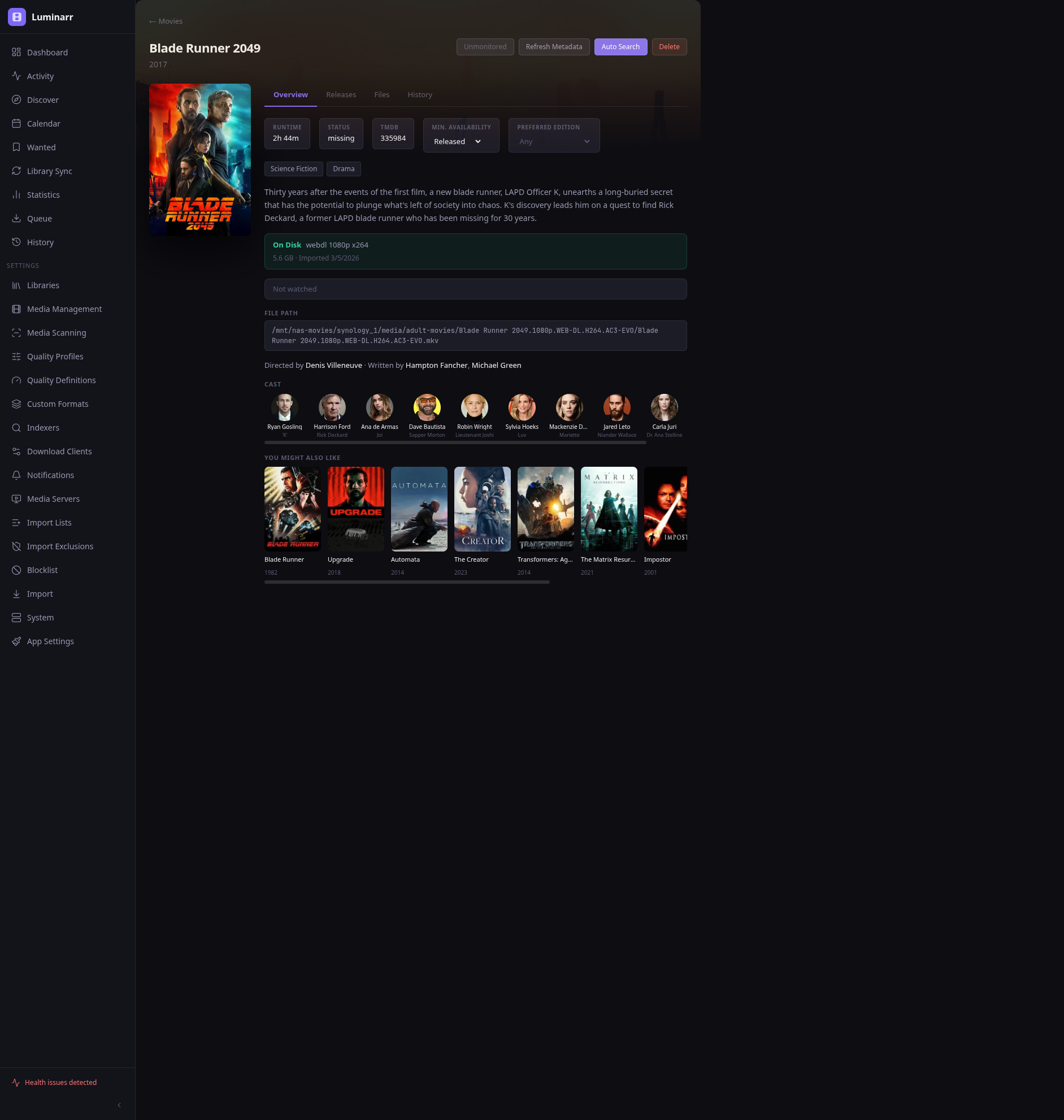
Movie detail — cast, crew, file status, watch history, and recommendations
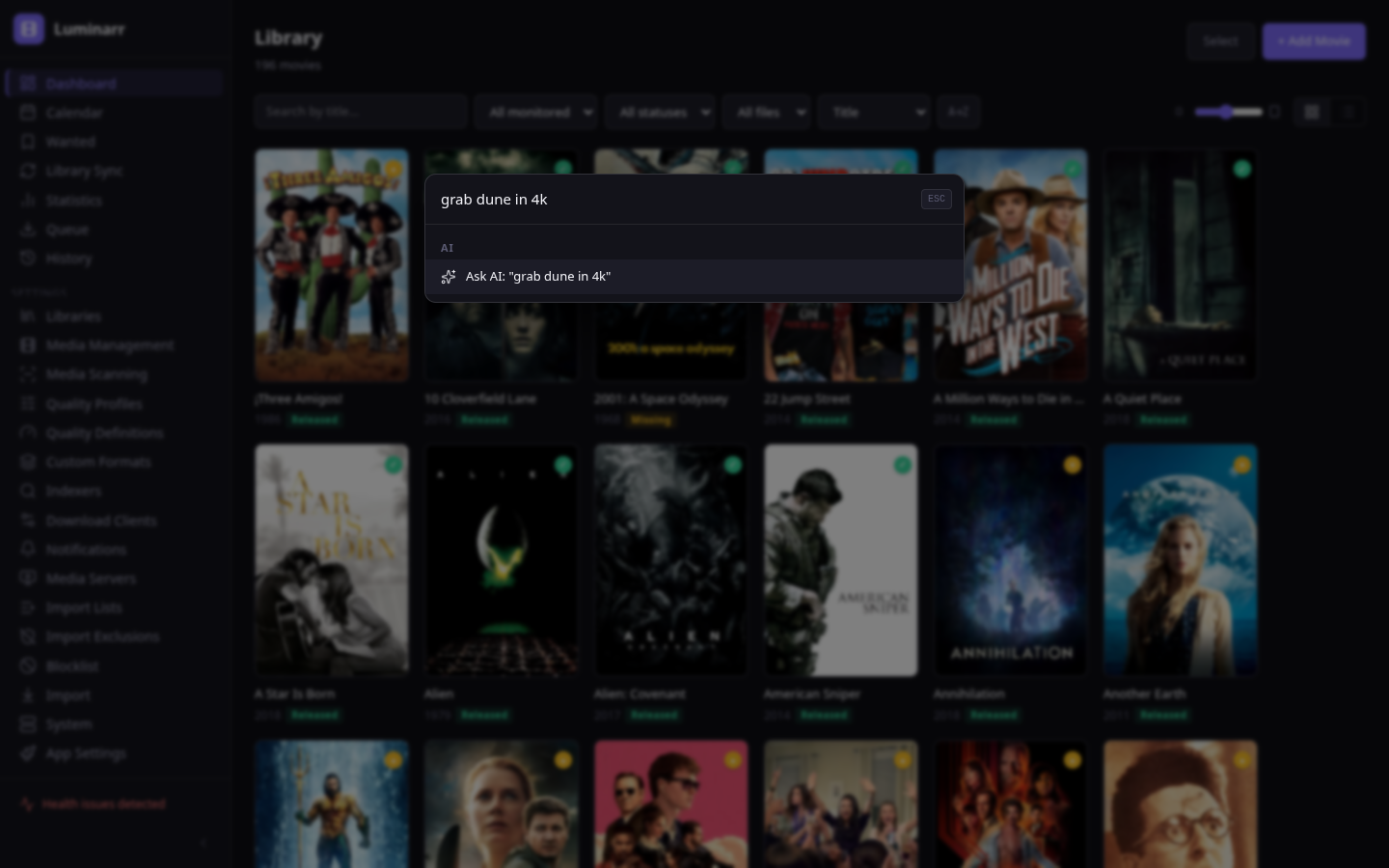
AI command palette — type what you want in plain English
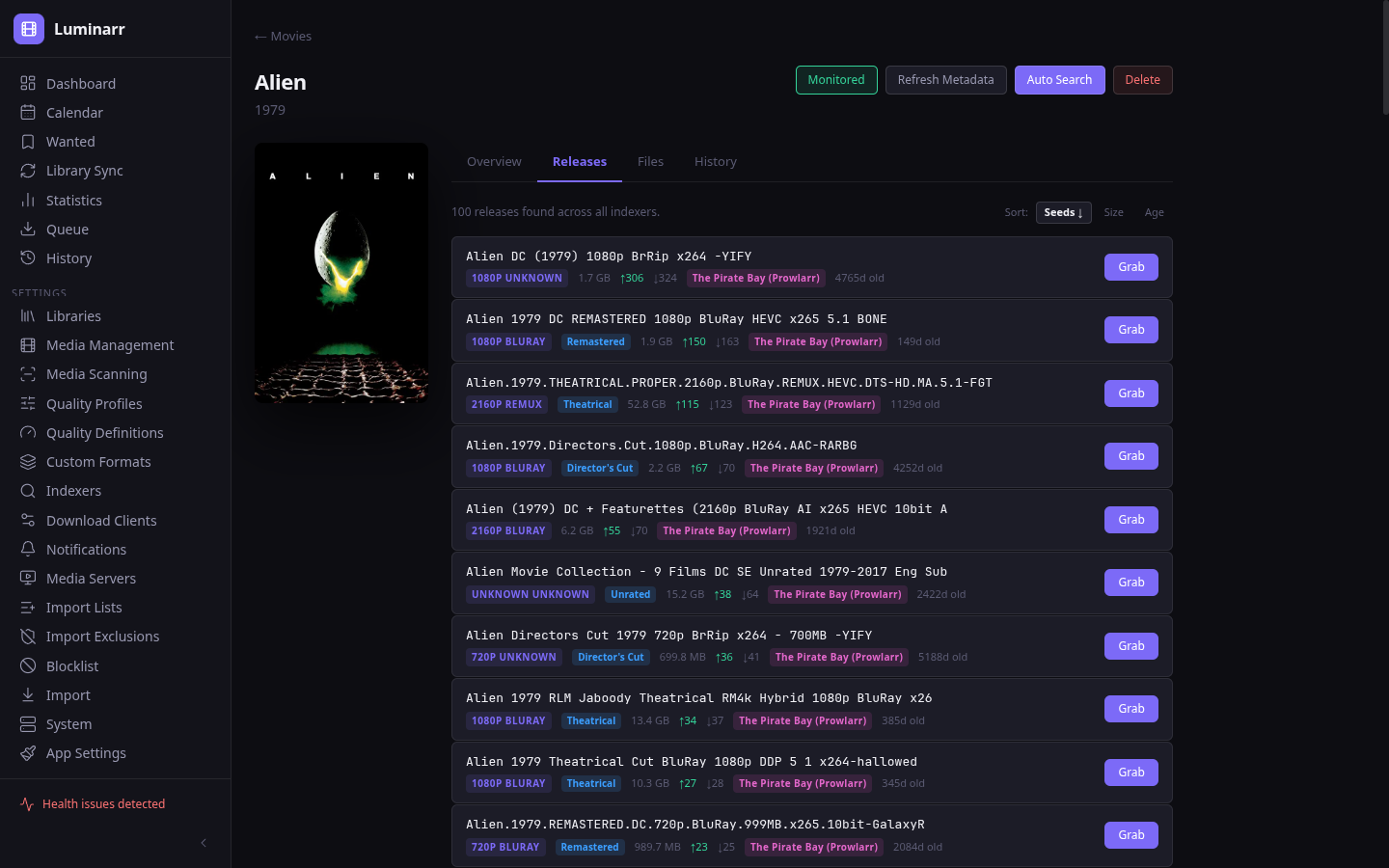
Manual search — browse releases with quality, edition, and seed info
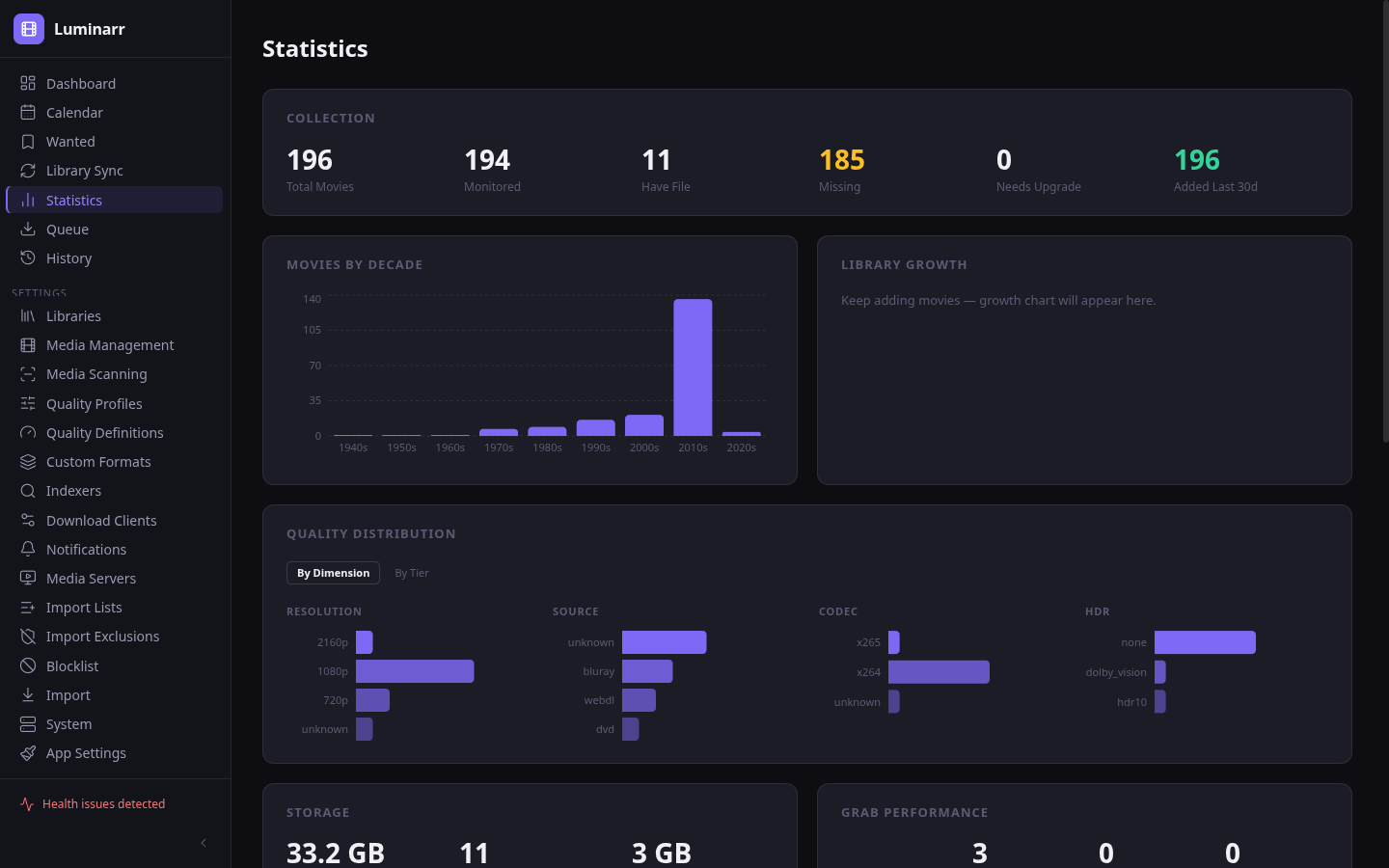
Library statistics — quality, decades, storage, and indexer performance
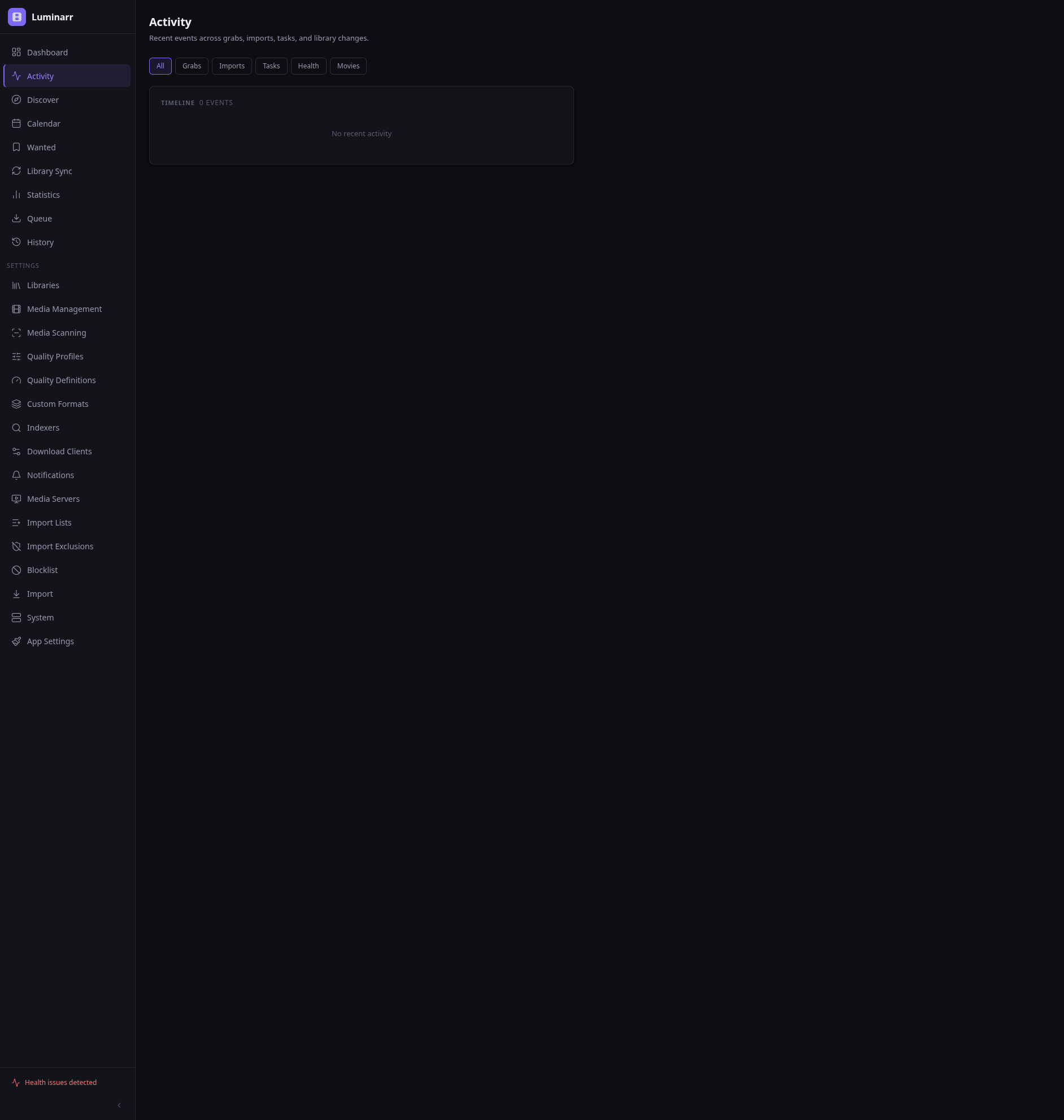
Activity — unified timeline of grabs, imports, tasks, and library changes
Quality profiles
Quality presets. Just check the box.
Each preset combines resolution, source, codec, and HDR into one line.
Check the ones you want, pick a cutoff, and you're done — no scoring rules to write.
HD-1080p
Profile
Resolution
Source
Codec
HDR
1080p
WEBDL
x264
None
✓
1080p
WEBRip
x265
None
✓
1080p
Bluray
x265
None
✓
1080p
Remux
x265
None
Cutoff1080p · Bluray · x265 · None
Features
Everything you need. Nothing you don't.
Movie gallery
Poster grid or list view. Filter by status, quality, library, and search. TMDB metadata, cast, and posters.
Full automation
RSS sync, automatic grabbing, downloading, and importing. File renaming, bulk editor, blocklist, and backup/restore built in.
Zero telemetry
No analytics, no crash reports, no update checks, no phone home. Credentials use a Secret type that redacts in all output.
One-click Radarr import
Import quality profiles, libraries, indexers, download clients, and your entire movie list from a running Radarr instance.
5 download clients
qBittorrent, Deluge, Transmission, SABnzbd, and NZBGet. Per-indexer seed ratio and time limits for private trackers. Live queue with WebSocket updates.
Media scanning
Optional ffprobe integration verifies actual codec, resolution, and HDR. Flags mislabelled releases with a mismatch badge.
9 notification channels
Discord, Slack, Telegram, Gotify, ntfy, Pushover, webhook, email, and custom scripts. Subscribe each channel to specific events.
Calendar & Wanted
Monthly calendar colour-coded by status. Wanted page shows missing and cutoff-unmet movies. Manual search with release comparison.
Library statistics
Decade distribution, collection growth, genre breakdown, quality and storage charts. Interactive dashboards powered by Recharts.
Media server sync
Compare your Plex, Emby, or Jellyfin library against Luminarr. See what's missing on each side and import with one click. Auto-refresh on import.
AI command palette
Optional Claude-powered natural language commands via Cmd+K. “Grab Dune in 4K”, “how many movies am I missing?”, “go to quality profiles.” State-modifying actions require confirmation.
Custom formats
Regex-based release matching with weighted scoring. 15 built-in TRaSH Guides presets, or create your own. Fully wired into auto-search scoring.
Release explainability
“Why was this grabbed?” Every release decision is explained: quality profile match, custom format scores, blocklist, and conflict warnings for audio/HDR regressions.
Import lists
Auto-add movies from TMDB (popular, trending, collections, persons), Trakt, Plex watchlists, MDBList, and custom lists. Runs on a schedule.
Custom scripts
Execute any code when events happen. Bash, Python, Ruby — your script, your language. Full guide →
In-memory ring buffer captures the last 1,000 log entries. View them in the UI with level filtering, color-coded badges, and auto-refresh. No external logging stack needed.
How we compare
Inspired by the best. Built from scratch.
Radarr pioneered automated movie management. Luminarr builds on that foundation with a fresh
tech stack, different trade-offs, and a few ideas of our own.
Radarr
Luminarr
Backend
.NET / Mono
Go
Frontend
Angular
React
Database
SQLite / Postgres
SQLite
Memory (idle)
300 – 500 MB
30 – 60 MB
Startup time
10 – 30 s
< 1 s
Quality system
Custom Formats + scoring
Explicit codec & HDR + Custom Formats
AI features
—
Natural language command palette (Claude)
Decision explainability
—
“Why?” button on every release
Import lists
Lists + RSS
TMDB, Trakt, Plex, MDBList, custom
Telemetry
Optional analytics
None
Download clients
6 clients
5 (qBit, Deluge, Transmission, SAB, NZBGet)
Notifications
7 channels
9 channels + custom scripts
Media server sync
—
Plex, Emby, Jellyfin
Migration
—
One-click import from Radarr
Ecosystem
—
Radarr v3 API built in
Migration
Switch from Radarr in four steps
Radarr keeps running during the import. There's no cutover moment.
Take your time, verify everything, then switch when you're ready.
1
Connect
Enter your Radarr URL and API key
2
Preview
See everything Luminarr found
3
Import
Pick what to bring over and click Import
4
Done
Profiles, libraries, indexers, clients, movies — all there
Ecosystem
Works with your existing tools
Luminarr speaks Radarr's API. Point your tools at Luminarr and they just work — no native integrations needed.
# Download the latest release$curl-Loluminarr \
https://github.com/luminarr/luminarr/releases/latest/download/luminarr-linux-amd64$chmod+xluminarr# Run it$./luminarr
Open http://localhost:8282 and you're good to go.
Privacy
Your data stays yours
Luminarr connects only to services you explicitly configure. Nothing else.
No telemetry
No usage data, events, or analytics are sent anywhere. Errors are logged locally only.
No crash reporting
Errors are logged locally and viewable in the built-in log viewer. No Sentry, no Bugsnag, no third-party services.
No update checks
Luminarr never contacts any server to check for updates. You update when you choose to.
Credentials are redacted
A Secret type renders as *** in all log output and JSON serialization. Keys never leak.
Transparency
Built with AI. Reviewed by humans.
Luminarr was built with Claude as the primary code generator, with human design and review throughout.
We think that's worth being upfront about.
Every architectural decision was made by a human and documented
Security-sensitive code was explicitly designed and reviewed
Consistent patterns throughout — no style drift halfway through
600+ tests across 42 packages — unit tests, plugin tests, and 59 API integration tests run on every change
Ready to try it?
MIT licensed. One binary. Takes 60 seconds to set up.